Showing posts with label Carpathia. Show all posts

Featured Article: The Report on the Loss of Titanic


After the sinking of Titanic, inquiries were held in the United States and the United Kingdom. The U.S. inquiry began on April 19, 1912, under Senator William Alden Smith, and the British inquiry began on May 2, 1912, under Lord Mersey.

Both inquiries reached similar conclusions:
 

  • The regulations on the number of lifeboats that ships had to carry were out of date.
  • Captain Smith had failed to take ice warnings seriously.
  • The lifeboats had not been properly filled or crewed.
  • The collision was the result of steaming into an area of danger at too high a speed.
  • Both inquiries strongly criticized Captain Lord of the SS Californian for failing to render assistance to Titanic.
  • Neither the White Star Line nor its parent company, International Mercantile Marine, were found at fault or negligent under existing maritime laws, as they had merely followed standard practice.


The US inquiry concluded that the crew had followed standard practice and that the disaster could be categorized as an "act of God".  

The British inquiry concluded that Smith had followed long-standing practice, which had not previously been shown to be unsafe, and that he had done only what other skilled men would have done in the same position. 

The British inquiry also stated that "what was a mistake in the case of the Titanic would without doubt be negligence in any similar case in the future".


AMERICAN INQUIRY

The final report was published on May 28, 1912. 
The report's key findings were:

  • A lack of emergency preparations had left Titanic's passengers and crew in "a state of absolute unpreparedness", and the evacuation had been chaotic: "No general alarm was given, no ship's officers formally assembled, no orderly routine was attempted or organized system of safety begun."
  • The ship's safety and life-saving equipment had not been properly tested.
  • Titanic's Captain Edward Smith had shown an "indifference to danger and was one of the direct and contributing causes of this unnecessary tragedy."
  • The lack of lifeboats was the fault of the British Board of Trade, "to whose laxity of regulation and hasty inspection the world is largely indebted for this awful tragedy."
  • The SS Californian had been "much nearer to Titanic than the captain is willing to admit" and the British Government should take "drastic action" against him for his actions.
  • J. Bruce Ismay had not ordered Captain Smith to put on extra speed, but Ismay's presence on board may have contributed to the captain's decision to do so.
  • Third-class passengers had not been prevented from reaching the lifeboats but had in many cases not realized until it was too late that the ship was sinking.


The report was strongly critical of established seafaring practices and the roles that Titanic's builders, owners, and crew had played in contributing to the disaster. It highlighted the complacency that had been prevalent aboard the ship and more generally in the shipping industry and the British Board of Trade.

Recommendations:

  • Ships should slow down on entering areas known to have drifting ice and should post extra lookouts.
  • Navigational messages should be brought promptly to the bridge and disseminated as required.
  • There should be enough lifeboats for all on board.
  • All ships equipped with wireless sets should maintain communications at all times of the day and night.
  • New regulations were needed to govern the use of radiotelegraphy.
  • Adequate boat drills were to be carried out for passengers.
  • Rockets should only be fired by ships at sea as distress signals, and not for any other purposes.


The presentation of the US report was accompanied by two speeches, one from Smith and one from Senator Isidor Rayner.

Towards the end of his speech, Senator Smith declared:

“The calamity through which we have just passed has left traces of sorrow everywhere; hearts have been broken and deep anguish unexpressed; art will typify with master hand its lavish contribution to the sea; soldiers of state and masters of trade will receive the homage which is their honest due; hills will be cleft in search of marble white enough to symbolize these heroic deeds, and, where kinship is the only tie that binds the lowly to the humble home bereft of son or mother or father, little groups of kinsfolk will recount, around the kitchen fire, the traits of human sympathy in those who went down with the ship. These are choice pictures in the treasure house of the affections, but even these will sometime fade; the sea is the place permanently to honor our dead; this should be the occasion for a new birth of vigilance, and future generations must accord to this event a crowning motive for better things.”


Senator Rayner's closing words drew applause from the assembly:

“The sounds of that awe-inspiring requiem that vibrated o'er the ocean have been drowned in the waters of the deep, the instruments that gave them birth are silenced as the harps were silenced on the willow tree, but if the melody that was rehearsed could only reverberate through this land "Nearer, My God, to Thee," and its echoes could be heard in these halls of legislation, and at every place where our rulers and representatives pass judgment and enact and administer laws, and at every home and fireside, from the mansions of the rich to the huts and hovels of the poor, and if we could be made to feel that there is a divine law of obedience and of adjustment, and of compensation that should demand our allegiance, far above the laws that we formulate in this presence, then, from the gloom of these fearful hours we shall pass into the dawn of a higher service and of a better day, and then, Mr. President, the lives that went down upon this fated night did not go down in vain.”


Senator Smith proposed three pieces of legislation:

  • A joint resolution with the House of Representatives to award a Congressional Gold Medal to Captain Rostron of the Carpathia.
  • A bill to re-evaluate existing maritime legislation.
  • Establish a commission to enquire into the laws and regulations on the construction and equipment of maritime vessels.


The report's recommendations on the regulation of wireless telegraphy were implemented in the form of the Radio Act of 1912, which mandated that all radio stations in the US be licensed by the federal government, as well as mandating that seagoing vessels continuously monitor distress frequencies.

The existing Wireless Ship Act of 1910 was also amended to add new regulations governing how wireless telegraphy aboard ships was to be managed.

Public Receptions

The inquiry was heavily criticized in Britain, both for its conduct and style of questioning. Even though Titanic was indirectly owned by the American company, International Mercantile Marine, the inquiry was seen as an attack on the British shipping industry and was criticized for having the audacity to subpoena British subjects. Many saw it as a display of disrespect to British honor.

The American reaction was generally positive. The New York Herald published a supportive editorial commenting: "Nothing has been more sympathetic, more gentle in its highest sense than the conduct of the inquiry by the Senate committee, and yet self-complacent moguls in England call this impertinent ... This country intends to find out why so many American lives were wasted by the incompetency of British seamen, and why women and children were sent to their deaths while so many British crew have been saved."

The American press welcomed the findings of the inquiry and accepted its recommendations, commending Senator Smith for establishing the key facts of the disaster.


BRITISH INQUIRY

The final report was published on July 30, 1912.

The lines of questioning at the inquiry had resulted in a detailed description of the ship, an account of the ship's journey, a description of the damage caused by the iceberg, an account of the evacuation and rescue. There was also a special section devoted to the circumstances of the SS Californian.

The report's key findings were:

  • Titanic's sinking was the result of colliding with the iceberg, not due to any inherent flaws with the ship, and that the collision had been brought about by a dangerously fast speed in icy waters.
  • Inadequate lookouts given the navigational hazards Titanic faced.
  • The ship's officers had been far too complacent about the ice warnings.
  • There were too few lifeboats available, and they had not been properly filled or manned with trained crew members, despite being lowered correctly. 


The inquiry also found that Captain Stanley Lord of the SS Californian "could have pushed through the ice to the open water without any serious risk and so have come to the assistance of the Titanic. Had she done so she might have saved many if not all of the lives that were lost."

The Board of Trade's representative suggested to Lord Mersey that a formal inquiry should be held into Captain Lord's "competency to continue as Master of a British ship" but no action was taken against him due to legal technicalities.
 

Public Receptions

The Board of Trade was criticized for its inadequate regulations, notably the failure to ensure that enough lifeboats were provided and that crews were given proper training in their use.

The report was well received by the British press. The Daily Telegraph commented that although "technically speaking, the report is not the last word, but in practice it would probably be treated as if it were." 

The Daily Mail stated that it was "difficult to suppose that any court which had to inquire into the responsibility of the owners of the ship would disregard the expression of opinion of Lord Mersey and those who sat with him ... The report having, in effect, acquitted them of all blame, it is not likely that any attempt will be made hereafter to establish the contrary."

Others were more critical.

In his memoirs, Titanic’s 2nd Officer Charles Lightoller pointed out the inquiry's conflict of interest:

"A washing of dirty linen would help no one. The Board of Trade had passed that ship as in all respects fit for the sea ... Now the Board of Trade was holding an inquiry into the loss of that ship – hence the whitewash brush."

American Titanic historian Don Lynch notes the consequences: 

"Apart from protecting itself, the Board of Trade had no interest in seeing the White Star Line found negligent. Any damage to White Star's reputation or balance sheet would be bad for British shipping – and there was considerable potential for both. Negligence on the part of the shipping company might pave the way for millions of dollars in damage claims and lawsuits that would tie up the courts for years, possibly break the White Star Line, and result in the loss of much of Britain's lucrative shipping traffic to the Germans and the French."


In the aftermath of both inquiries, major changes in maritime regulations implementing new safety measures, such as ensuring that more lifeboats were provided, that lifeboat drills were properly carried out and that radio equipment on passenger ships was manned around the clock. 

Radio operators were to give priority to emergency and hazard messages over private messages. Rivaling international wireless networks, such as the British Marconi Company and the Telefunken Company of Germany, were required to handle all radio calls including those of the other network. 

An International Ice Patrol was set up to monitor the presence of icebergs in the North Atlantic, and maritime safety regulations were standardized internationally through the International Convention for the Safety of Life at Sea (SOLAS).

Featured Article: Lord Mersey and the British Wreck Commissioner's Inquiry into the Loss of Titanic


Just days after the United States inquiry had begun, the British government followed suit and order their own formal inquiry into the loss of Titanic. 

On Monday, April 22, 1912, Charles Bigham, Lord Mersey of Toxteth was appointed to fill the seat of Wreck Commissioner at the request of the British Board of Trade President, Sydney Buxton. 


Assisting Mersey as assessors would be...
J. Harvard Biles, Professor of Naval Architect at Glascow
Rear Admiral Somerset Arthur Gough-Calthorpe RNR
Edward C. Chaston, Engineer
Captain A. W. Clarke
Commander F. C. A. Lyon RNR

The inquiry began in London on Tuesday, May 2, 1912, and lasted for 36 nonconsecutive days ending on July 3rd. During the span of the inquiry, approximately 98 witnesses were called to testify answering more 25,000 questions. Testimony was heard from White Star Line officials, government officials, surviving passengers and crew, and those who had aided the rescue efforts. The questioning resulted in a report that contained a detailed description of the ship, an account of the ship's journey, a description of the damage caused by the iceberg, and an account of the evacuation and rescue.

Surviving crew members who testified included the most senior surviving officer, 2nd Officer Charles Lightoller, Lookout Frederick Fleet who was on duty at the time of the collision, the surviving wireless operator Harold Bride, and the ship's baker Charles Joughin.

Those from other ships who gave testimonies were Captain of the RMS Carpathia Arthur Rostron, Carpathia's Wireless Operator Harold Cottam, Captain of the SS Californian Stanley Lord and many of the Californian's crew, and Captain of the RMS Baltic J. B. Ranson.

Other witnesses included Guglielmo Marconi of the Marconi Company, explorer Sir Ernest Shackleton, and Harold Arthur Sanderson, UK Vice President of International Mercantile Marine Company.
White Star Line officials that testified included the President of the Line J. Bruce Ismay and Superintendent Charles Alfred Bartlett.

To assist the inquiry, Titanic's builders Harland & Wolff provided a 20-foot-long half-model of the ship showing its starboard side, next to which was a large map showing the North Atlantic shipping lanes and locations of sea ice.


From Harland and Wolff, evidence was given by Naval Architect Alexander Carlisle who was the brother-in-law of the shipyard's chairman. Carlisle and Pirrie were initially responsible for the design of the Olympic-class liners. Carlisle had retired in 1910, and like Pirrie had not travelled on the maiden voyage of Titanic. The lead designer on board had been Thomas Andrews, Pirrie's nephew, who went down with the ship.

Sir Cosmo and his wife Lady, Lucy Duff-Gordon

The only passengers to testify, other than Ismay, were Sir Cosmo Duff-Gordon and his wife Lucy, Lady Duff-Gordon. 

The questioning of the Duff-Gordons and the Californian's crew were seen as highlights of the inquiry.

The testimony of the Duff-Gordons, who had been accused of misconduct for their actions in leaving Titanic aboard a lifeboat with 40 seats but only 12 passengers, attracted the largest crowds.


The failure of Californian to go to the rescue of the sinking Titanic, which had been disclosed by the American inquiry, was already controversial and became even more so with the testimony of Captain Lord and his officers. Lord's claims and explanations were contradicted by his officers, and he was portrayed by them as an intimidating and somewhat tyrannical figure.

Captain Stanley Lord and the SS Californian

Although Lord appeared only as a witness and was not accused of wrongdoing, his public image was forever tarnished as being the captain of the ship that watched Titanic sink on the horizon and never came to her assistance.

See Articles: 
Carpathia Receives All of Titanic's Survivors. Californian Is Too Late to Help.


The final report was published on 30 July 1912.

The report found that Titanic's sinking was solely the result of colliding with the iceberg, not due to any inherent flaws with the ship, and that the collision due to dangerously fast speed in icy waters. Although, it was found that Titanic's captain E. J. Smith was at fault for not changing course or slowing down, he had not been negligent because he had followed long-standing practice which had not previously been shown to be unsafe.

It was also found that Titanic officers had been too complacent given the navigational hazards, that there were not enough lifeboats, and were not properly filled or manned with trained crew.

There was also a special section devoted to the circumstances of Californian.
The inquiry concluded that Californian could have made it through the ice and into the open water without any serious risk. If done so she might have saved many if not all of the lives that were lost in the disaster.

It was suggested that a formal inquiry should be held into Captain Lord's competency to continue as a captain, but no action was taken due to legal technicalities. 

The Duff-Gordons were cleared of any wrongdoing, but their reputation was forever damaged.

Compared to the American inquiry, the British inquiry did not condemn the Board of Trade, White Star Line, or Titanic's captain, Edward Smith. 

The British Board of Trade was criticized by the public for its inadequate and outdated regulations, notably the failure to ensure that enough lifeboats were provided and that crews were given proper training in their use. Because of this and many other factors, over the span of history the British Inquiry into the loss of Titanic has been called a "whitewash" by blaming others for the disaster and excusing themselves.

The British inquiry into the loss of Titanic was the longest and most detailed inquiry in British history up to that time.


Featured Article: Senator Smith and the United States Senate Inquiry Into the Loss of Titanic


Senator William Alden Smith and his son had made a North Atlantic voyage aboard the Baltic under the command of Captain E.J. Smith in 1906. Captain Smith would later be the commander of Titanic in 1912. While aboard the Baltic, the senator had the chance to meet Captain Smith and developed a great respect for the man. After Titanic went down, the senator was determined to find out why the largest and most state-of-the-art ship in the world went down at the command of one of the most experienced and respected captains on the sea?


Senator William Alden Smith (left) and Captain E.J. Smith (right)


He telephoned to Charles Hilles, Secretary to President Taft, to ask what action was to be taken. The reply was that the President intended to do nothing. After hearing this, he began working on a draft of a resolution to investigate the disaster.

Early morning of Thursday, April 18th, word had been received showing that there were no other survivors of the disaster, except for those aboard the Carpathia. The true scope of the disaster was now apparent to all. Shortly after hearing the news of the true reality of the survivors, the Senate met that same morning and the floor was turned over to Senator Smith, who immediately asked for passage of his resolution which authorized the Committee on Commerce to investigate the disaster. 

The resolution called for a hearing with witnesses being subpoenaed who could offer information about the disaster. With very little opposition the resolution was carried, and Smith was appointed by the Commerce Committee chairman, Knute Nelson, as chairman of the subcommittee to look into the Titanic disaster. Neslon and Smith spent the remainder of the day selecting the panel of Senators that would aid him in the inquiry.

J. Bruce Ismay
Later that morning, the Department of the Navy contacted Senator Smith, advising him that they had intercepted several significant messages being sent from the Carpathia by Bruce Ismay, President of the White Star Line. 

Other than announcing the loss of Titanic and requesting personal needs, some of telegrams that were intercepted indicated that Ismay was hoping to go directly back to England, along with the crew, without setting foot on American soil. Some of these messages were signed with the name "Yamsi". It didn't take much to interoperate that Yamsi was Ismay spelled backwards.

At noon, Smith immediately arranged a  meeting at the White House. During the meeting, Smith asked about the legalities of subpoenaing British citizens. President Taft, checking with Attorney-General George Wickersham, said there was no question so long as they were in the United States.

That afternoon, the first meeting of the investigative subcommittee was held, during which the Ismay messages were discussed. Smith asked which of the other Senators would accompany him to New York to serve subpoenas and interrogate witnesses.

That evening at around 9:30pm, Titanic survivors begin to disembark the Carpathia shortly after her arrival.

Ismay had hoped for a quick return to England for himself and the surviving crew members by immediately boarding another White Star ship, most likely the Cedric. However, that hope was quickly diminished with the arrival of Senator Smith and his men, intercepting Ismay and the others before they could disembark the Carpathia. The men carried subpoenas for Ismay, as well as various members of the Titanic crew.

Smith also was accompanied by Senator Francis G. Newlands, US Steamship Inspector General - George Uhler, Sheriff Joe Bayliss (an old ally of Smith's that was deputized as an Assistant Sergeant at Arms of the US Senate specifically to serve subpoenas), and Bill McKinstry (Smith's private secretary).

The inquiry began at the Waldorf-Astoria Hotel in New York City the following morning on Friday, April 19th. After two days, the inquiry was moved to Washington D.C. All together inquiry lasted 18 days and recorded the testimonies of 86 witnesses.


Timeline Article: Survivor Lists Become More Accurate / Southampton Is Hit Hardest By The News of Titanic

Friday, April 19, 1912
Morning

The lists of names of Titanic's survivors become more accurate after Carpathia's arrival in New York. Crowds of people gather outside the White Star offices in both America and the United Kingdom. They watch with hope and fear for familiar names.

Southampton is hardest hit by the news that only about 200 of Titanic's 900 crew members were saved. The majority of Titanic's crew were recruited directly from Southampton not long before Titanic departed. 


The London Daily Mail reports:
"In the humble homes of Southampton, there is scarcely a family that has not lost a relative or friend."

Timeline Article: Titanic's Survivors Disembark

Carpathia at the New York docks

Thursday, April 18, 1912
Around 9:30pm

Darkness and heavy rain have delayed the warping of the Carpathia to the dock. A crowd of 10,000 to eventually 30,000 people have gathered, and are awaiting the arrival of Titanic's survivors. Among the crowd is a large detachment of city officials, immigration commissioners, doctors, priests, sisters, nurses, ambulances, and coroners. The Salvation Army is also there to care for the survivors of Titanic’s steerage passengers. Delegates from the New York Stock Exchange have sums of cash for those who have lost everything. Organizations such as the Boy Scouts of America along with many others have set up fundraisers to help those in need.

The Boy Scouts of America collecting money
to help support Titanic's survivors.

Once the Carpathia was tied to the dock and the gangway prepared, a large number of stretchers were taken aboard. As Titanic's passengers began making their way down the gangway it soon became evident to the crowd that a large number of survivors had lost all their clothing, and had to make due with whatever was available to them aboard the Carpathia. Some were ill physically and or mentally. Others were violently hysterical, and evidently deranged, while there were a considerable number of cases that were in a state of shock. As the survivors made their way to the street, silence fell over the crowd, and even the flashes of the Press photographers' cameras ceased for a moment.

Titanic's surviving Wireless Operator
Harold Bride being carried from the
Carpathia.


Dr. Henry Frauenthal and his wife were the first to land from the Carpathia. They were driven off quickly in a motor car, and no one had any opportunity to speak to them. Many soon followed in the same manner. 

Some of the survivors needed assistance getting down the gangway such as Titanic's Wireless Operator Harold Bride who had injuries to his feet. One was sprained and the other had frostbite.


As Titanic's survivors disembark, the people in the crowd started shouting out names in hopes to get a response. The people that were reunited with their loved ones clung to them and kissed them tenderly. 

The sick and injured of Titanic's survivors were carried on stretchers and taken to a hospital by ambulance. 

For the others that waited and waited but never saw their loved ones, it was a horrible reality. Out of the 2,208 people aboard Titanic only 712 survived. That meant 1,496 were dead.


One man in the crowd waiting to greet the survivors is William Alden Smith, a U.S. Representative and Senator from the state of Michigan. He has been appointed to investigate the sinking of Titanic. Senator Smith along with a group of U.S. marshals board Carpathia. He has a handful of subpoena, one of which is for Bruce Ismay. The investigation hearings begin the very next day and Senator Smith wants Ismay to be there.


Senator William Alden Smith (left) and
White Star Line President J. Bruce Ismay (right)


Timeline Article: Carpathia Arrives in New York with Titanic's Survivors

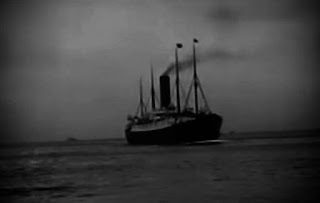
Carpathia approaching New York.

Thursday, April 18, 1912
Evening

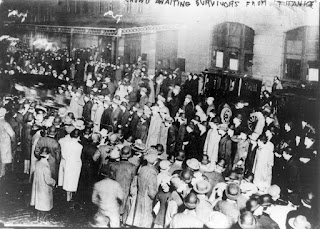
By 6pm, Carpathia slowly makes her way through the dark and rainy evening, a harbor pilot from the Ambrose lightship is brought aboard as well as an escort of tugboats to lead her into New York. Private craft surround Carpathia. Photographers' camera flashes light up the evening and reporters shout out questions with megaphones. One reporter manages to board the ship only to be grabbed by crew members and taken below deck. Some people in the boats surrounding Carpathia hold up signs asking for Titanic survivors by name. Nearly 30,000 people gather at the Cunard's pier 54 braving the rain and cold waiting for Carpathia to arrive. Nearly all of New York's police force was on duty. Hundreds of officers were required to hold back the crowds of people. Many were relatives of the survivors desperately seeking answers.

Crowds of people waiting for Carpathia to arrive
with Titanic's survivors.

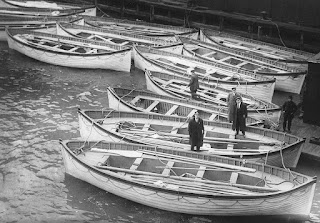
Around 8pm, Carpathia appears out of the rainy darkness only to be lit up by the constant flashing of photographers' cameras. The crowds watch in confusion as Carpathia slowly moves past her Cunard pier 54 and stops at White Star's pier 59. After a few moments it all becomes clear as Carpathia's crew begin unloading Titanic's lifeboats at the pier where Titanic would have docked. Only 13 lifeboats were all the remained of the great liner.


Titanic's 13 remaining lifeboats dropped off by
Carpathia at Titanic's pier.

After all of Titanic's lifeboats were unloaded from Carpathia's deck, she slowly makes her way back to the Cunard dock. The crowd grew silent as the gangplank was lowered, and by 9:30pm Titanic's survivors began to disembark.


Timeline Article: The Uneasiness Aboard Carpathia

Titanic's survivors aboard Carpathia

April 15 - 18, 1912

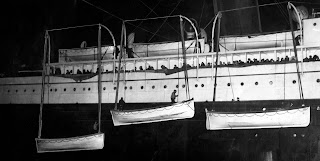
Titanic's survivors settle into their crowded new quarters among Carpathia's sympathetic passengers and crew. Under these conditions the ship is too small to allow anyone much privacy. The passengers and crew share or give up their cabins to their cold and fatigued guests. The common areas of the ship are soon filled causing many to move out onto the decks. Titanic's recovered lifeboats loom over them as a haunting reminder. Among the crowds, some family members are reunited. Newly made widows recalling the recent deaths of their husbands, are tortured by the presence of men that have survived.

Titanic's lifeboats on the deck of Carpathia

Then on Tuesday night, Carpathia runs into a thunderstorm. On Wednesday she encounters heavy fog that doesn't clear until Thursday afternoon. The bad weather frightens many of the survivors. By the time the fog clears many can hear the Fire Island fog horn. New York City is only hours away.

Fire Island Lighthouse

Timeline Article: Olympic Officially Informs New York About Titanic

RMS Olympic
Monday, April 15, 1912
6:15pm New York Time

Throughout the day, the people of New York City have heard nothing but rumors. 
With no real news on what has happened, all the conflicting and confusing stories begin to seem true. 

Finally, at 6:15pm Olympic sends New York a simple message, 
"Titanic has gone down". 

White Star Line's Phillip Franklin announces it to the American public. The news crosses the Atlantic by cable. The first numbers appear listing that only 675 passengers and crew were rescued. For a ship that had a crew of 900, this could mean the worst for Southampton, England where nearly all of Titanic's crew were employed. 

New rumors start to circulate when London's Daily Sketch makes an unsupported claim that the Carpathia with Titanic's survivors on board had also begun to sink. Lists showing the names of Titanic's survivors are posted. Some of the names posted are misspelled, then corrected, or even omitted as vague new reports come in.

There will be no relief to the confusion until Carpathia arrives.


People gather outside The Sun Building in New York
awaiting news about Titanic.


Timeline Article: Cottom And Bride Send Messages from Carpathia

Harold Cottom
Carpathia's wireless operator Harold Cottom has been on duty all night. He is completely exhausted and overwhelmed. He has a huge number of official messages that must be sent out informing the world of Titanic's sinking as well as messages going out from survivors. On top of that, Captain Rostron wants a complete list of survivors to be sent out as quickly as possible.


Harold Bride

Titanic's wireless operator Harold Bride decides to assist Cottom with the outgoing messages. Despite his exhaustion and frostbitten feet, he relieves Cottom at the wireless whenever necessary.

During voyage to New York, Carpathia's signal will be broadcasting constantly. Cottom and Bride will ignore all incoming messages from news reporters and including President Taft. The two men have both committed themselves to serving Titanic's survivors.

Timeline Article: Bruce Ismay - A Man Completely Wrecked

J. Bruce Ismay
Monday, April 15, 1912
Mid-Day

On board the Carpathia, White Star's president 
J. Bruce Ismay, hands over a message for the New York office to Captain Rostron which reads:


"Deeply regret advise you. Titanic sank this morning after collision iceberg. Resulting in serious loss of life. Full particulars later."
-Bruce Ismay

Ismay sits alone in the doctor's room. Shocked, defeated, and overwhelmed by guilt. At the doctor's request, fellow survivor 17-year-old Jack Thayer, tries to offer some comfort to Ismay.


Jack Thayer
"He was staring straight ahead. Shaking all over like a leaf. Even when I spoke to him, he paid absolutely no attention. I have never seen a man so completely wrecked."
-First Class Passenger
 Jack Thayer


Timeline Article: Carpathia Proceeds to New York with Titanic's Survivors

RMS Carpathia
Monday, April 15, 1912
8:50am

After departing New York just a few days before, Carpathia was on a vacation cruise upon receiving Titanic's distress call. Now this pleasant cruise has become a mission of mercy.

With 700 additional passengers, the spaces aboard Carpathia have become limited.


Titanic's passengers crowd the decks and saloons as Carpathia's passengers try to offer aid and comfort. Captain Rostron sails his ship to the location of the sinking. Some wreckage and one floating body are visible.

The ice field is a low wall that is blinding white in the sun. One of the icebergs stands out with what appears to have a spear of Titanic's red paint at its base. 

A photograph taken of the ice field with bergs visible.

Captain Rostron asks his purser and steward for a full survivor count and prepares to return to New York. Before leaving the area, Rostron makes one more request to have a brief funeral for the victims. Titanic's survivors are overwhelmed by grief.


Timeline Article: Carpathia Receives All of Titanic's Survivors. Californian Is Too Late to Help.


Monday, April 15, 1912
8:30am

Captain Arthur Rostron of the Carpathia
Carpathia's crew finish receiving Titanic's survivors around 8:30am. Once everyone is on board, Captain Rostron asks for a full survivor count.

The survivors immediately begin looking for family and friends that had been separated during Titanic's evacuation. The married women search for their husbands that they were forced to leave behind. Unaware that Carpathia was the only ship to come to Titanic's rescue, many of the survivors have hope that their loved ones could possibly be on another ship.

After traveling through 19 miles of ice, the Californian approaches the Carpathia from the north. Californian's Wireless Operator Cyril Evans has just learned of Titanic's fate, and has relayed this information to Captain Stanley Lord.

After hearing this horrible news, Lord and the rest of his crew can't help but wonder if the rockets and lights they saw disappearing on the horizon, was actually the Titanic sinking before their eyes. As Californian gets closer to Carpathia, they realize that they are too late to help.

Captain Stanley Lord and his ship, SS Californian

See Related Articles: Californian Notices RocketsThe Mystery Ship


Timeline Article: The First Lifeboat Reaches Carpathia. Boxhall Informs Rostron of What Has Happened.

4th Officer Boxhall (left) and Captain Rostron (right)
Monday, April 15, 1912
4:10am
After arriving at the scene, the Carpathia drifts toward Lifeboat 2 with 4th Officer Boxhall in command. The passengers of this boat are brought aboard.
Boxhall informs Captain Rostron that Titanic went down early that morning and that hundreds, maybe even a thousand, went down with her. All of Titanic's remaining passengers and crew make their way toward the Carpathia.

By 8:30am all of the survivors have been brought aboard. Thirteen of Titanic's lifeboats are recovered and stored on Carpathia's deck.


Timeline Article: Carpathia Arrives!


Monday, April 15, 1912
3:30am - 4am

It has been nearly four hours since Carpathia had first responded to Titanic's distress call. Captain Rostron was getting everything and everyone ready to receive Titanic's survivors, all while pushing through the icy Atlantic at top speed. The Carpathia reaches Titanic's reported position around 3am to 3:30am only to find nothing. Carpathia sends a message to Titanic saying, "If you are there, we are firing rockets.".

As dawn appeared, all that was left of Titanic were her lifeboats. They were scattered for miles across the horizon among hundreds of icebergs.


"It was at quite an early stage that I had seen that I had seen far in the distance, the unmistakable mast lights of a steamer about four or five points away on the port side. My eyes were fixed for hours that night on the lights of that steamer far away in the distance, which afterwards proved to be those of the Carpathia. To my great disappointment they seemed to make no progress towards our rescue. This we were told later, was due to meeting an iceberg as she was proceeding full speed to the scene of the Titanic's wreck. She had come to a stop, and sighted the lights of our lifeboats, or such has had them. Finally, dawn appeared and there on the port side of our upset boat where we had been looking with anxious eyes, glory be to God! We saw the steamer Carpathia about four or five miles away with other Titanic lifeboats rowing towards her."

Titanic's First Class Passenger
Col. Archibald Gracie


With the new light of dawn and with Carpathia visible in the distance, Titanic's survivors begin rowing toward the rescue ship. Some of the lifeboats are reorganized and tied together by Titanic's surviving officers before proceeding. The overturned collapsible B is sinking fast and it's passengers are transferred to other lifeboats close by. Many of the the lifeboats that were overloaded had their passengers transferred to other boats as well.

The rescue of Titanic's survivors has begun.


See Related Article: Carpathia Responds / Titanic's Situation Becomes Clear


Timeline Article: Last Rocket is Fired


Monday, April 15, 1912
1:50am

For almost an hour, 4th Officer Boxhall and Quartermaster Rowe have been firing distress rockets. This was an attempt to get the attention of any ship that may be near by, but mainly to get the attention of the ship that was spotted earlier on the distant horizon. After Boxhall had been ordered to take command of Lifeboat 2 by Captain Smith, Quartermaster Rowe continued to fire rockets. It is unknown how many rockets were fired in total, but only that there were no more rockets fired after 1:50am, just shortly before Rowe was ordered to take command of Collapsible C. The Carpathia is the only ship that has responded to the wireless operator's distress calls and is heading for Titanic's position at her top speed. However, she is still too far away and will not make it in time.


Timeline Article: Titanic Has Less Than An Hour To Live


Nine of Titanic's lifeboats have been launched and there is no rescue ship is in sight. Even though Carpathia has responded, she is still 3 hours away from Titanic's location. The fact that the unsinkable ship is actually sinking has become apparent to everyone, and the horrible reality of the situation begins to set in. Titanic will disappear beneath their feet before help arrives. To the people aboard, the evacuation of Titanic is no longer a precautionary measure, it is now a life or death situation.


Timeline Article: Carpathia Responds / Titanic's Situation Becomes Clear


Monday, April 15, 1912
12:19am - 12:27am

As Titanic sinks, wireless operator Phillips continues to send CQD calls...
58 miles away, wireless operator Harold Cottom aboard the Cunard Line's Carpathia, (pictured above) hears Titanic's distress call while getting ready for bed.

Wireless Operator Cottom and Captain Rostron
of the Cunard liner Carpathia.
Cottom writes down what he has heard from Titanic. He responds instantly and asks for Titanic's position. Then he runs to the bridge and informs First Officer Dean and then wakes Captain Rostron with the news.

Meanwhile on Titanic, wireless operator Harold Bride informs Captain Smith that Carpathia has responded, that they are traveling at full speed, and that they will reach Titanic's location within 4 hours. Smith is stunned that Carpathia is the only ship responding to their rescue. Titanic has at most 2 hours to live. 

Wireless Operator Bride and Captain Smith of Titanic.


Video Provided By: "A Night To Remember" (1958) / "Titanic" (1997)