Showing posts with label Belfast. Show all posts

Featured Article: The Story of Nomadic - The Last Surviving Vessel of the White Star Line

The S.S. Nomadic is a tender that was specially designed and built by White Star to serve the Olympic Class ships. Olympic and Titanic were so large that they could not dock in Cherbourg, France, but had to wait off shore while Nomadic and her sister ship Traffic, brought passengers from the dock to the ship. Nomadic still exists today and is under restoration at Harland and Wolff in Belfast, Northern Ireland. She is the only surviving vessel of the White Star line.

NOMADIC TIMELINE

December 22, 1910

Nomadic's keel is laid down at Harland and Wolff shipyard in Belfast.

April 25, 1911

Nomadic is launched.

The launch of the SS Nomadic


May 16, 1911

Nomadic completes sea trials.

May 27, 1911

Nomadic is delivered to the White Star Line.

June, 1911

Nomadic arrives in Cherbourg, France.

June 14, 1911

Nomadic services RMS Olympic at Cherbourg. This was Olympic's maiden voyage and first stop on her way to New York.

April 10, 1912

Nomadic ferries 142 first class passengers to Titanic. This was Titanic's maiden voyage and first stop on her way to New York.


Titanic and Nomadic at Cherbourg, France
Image from James Cameron's 1997 film "TITANIC"


June, 1912

Nomadic receives a covered bridge.

SS Nomadic with covered bridge.


World War I Begins

1917

Nomadic is requisitioned by the French government, and is sent to Brest to serve as a troop ship for the U.S. 7th infantry division for nearly 2 years.

1919

Nomadic returns to commercial service. The first ship she tenders is the Cunard Line's Coronia.

1928

Nomadic is involved in a collision with the liner Orinoco.

1933

Cherbourg opens a deep water berth making tenders redundant.

1934

Nomadic is purchased by Societe Cherbourgeoise de Remorquage et de Sauvetage (SCRS) and is renamed Ingenieur Minard.

1936

She is dry docked in Cherbourg for essential repairs before continuing to serve some of the world's most famous liners.

World War II Begins

June 16, 1940

Nomadic helped to evacuate soldiers and workers from the French aviation company Amiot to escape the German army.

June 18, 1940

Nomadic sails to Portsmouth and is requisitioned by the British government. She spends five years as a troop ship, ferrying soldiers from Portsmouth to training camps in the Isle of Wight.

1945

Nomadic is saved from scrapping by her former owner SCRS.

1945-1952

Nomadic is busy working at Cherbourg due to the harbor being virtually destroyed by the German army during the war. When the quays are restored, she becomes redundant and is kept for times when vessels can not berth.

1952

She also continues to service some visits of RMS Queen Mary and RMS Queen Elizabeth, the two largest liners in the world when they can not tie up at the quay.


Cunard White Star's RMS Queen Elizabeth with Nomadic in the lower left corner.
At this point in her career Nomadic was named Ingenieur Minard.


November 4, 1968

Nomadic serves the RMS Queen Elizabeth for the last time.

1969

French businessman Roland Spinnewyn purchases Nomadic and tows her from Cherbourg to Conflans Sainte Honorine with the intention of transforming her into a floating restaurant.

1974

Spinnewyn decides his dream is not practical, so Nomadic is sold to entrepreneur Yvon Vincent.

1977

Vincent opens Nomadic as a floating restaurant and function space on the River Seine in Paris where she plays host to many events and concerts over the following 22 years. Details of her internal layout are changed by each new tenant.


Nomadic on the River Seine in Paris serving as a floating restaurant.


March, 1999

Nomadic is closed due to Health and Safety regulations requiring annual inspections of her hull in dry docks.

April 1, 2002

Nomadic is towed out of Paris and down the River Seine to Le Havre.

January 26, 2006

Nomadic is purchased by the Department of Social Development.

July 12, 2006

After 95 years Nomadic returns to Belfast for restoration.

Harland and Wolff continue the restoration project of Nomadic. While the restoration is on going, Nomadic serves as a museum and is part of the new Titanic Quarter and Titanic Belfast attraction in Belfast, Northern Ireland.


Nomadic as she currently looks today in Belfast, Ireland.


Timeline Article: Titanic's Sea Trials Are Conducted


Tuesday, April 2, 1912
6am

Two days after her completion, Titanic begins her sea trials. The small crew and officers assigned to Titanic take her out into Belfast Lough where they practice making turns and other handling characteristics. Then they steam into the open waters of the Irish Sea.

Over the course of about 12 hours, Titanic was driven at different speeds, her turning ability was tested and a "crash stop" was performed in which the engines were reversed from full ahead to full astern, bringing her to a stop in 850 yards, or 3 minutes and 15 seconds. The ship covered a distance of about 80 nautical miles (92 miles), averaging 18 knots (21 mph) and reaching a maximum speed of just under 21 knots (24 mph).

On returning to Belfast at about 7pm the surveyor signed an "Agreement and Account of Voyages and Crew", valid for 12 months, which declared the ship seaworthy.

Satisfied with her performance, Harland and Wolff officials proclaim her fit to sail. Bruce Ismay accepts her on behalf of the White Star Line.

By 8pm, Titanic leaves Belfast for Southampton to prepare for her maiden voyage.


Timeline Article: TITANIC - The Largest Ship in the World is Completed!


Sunday, March 31, 1912

TITANIC, the largest liner in the world is completed.
At 882 feet 9 inches long and 92 feet 6 inches wide, she had the same dimensions as her older sister. Her hull was built with two thousand, one inch thick steel plates, held together with over three million rivets. Her Gross Registered Tonnage is 46,383 tons, just a 2% increase over Olympic at 45,324 tons, making Titanic the larger ship.

Titanic's Central Anchor

Titanic had three main anchors, one for each side of the bow, and with a central anchor stored in reserve on the forecastle deck. The port and starboard bow anchors weighed 7 7/8 tons each, and the central anchor weighing 15 3/4 tons. The bow anchors were raised and lowered with 96 tons of anchor chain.

29 boilers will produce enough steam to power her three story tall reciprocating engines and single turbine, generating up to 46,000 horsepower total. The port and starboard reciprocating engines turned the outer wing propellers, both at 23ft. in diameter, and the single turbine turned the center propeller which was 16ft. in diameter. Titanic and Olympic were called "triple screw steamers" because they were equipped with three propellers.


Boilers waiting to be installed on Olympic and Titanic.

Titanic's Engines waiting to be installed.

Titanic's Central Turbine Rotor at Harland and Wolff.

Olympic's Triple Screws. Almost identical to Titanic's.
Titanic had a 3-bladed central screw.


The cost of building and equipping Titanic came to 1.5 million British Pounds,
or 7.5 million U.S. Dollars.
 
Titanic would cost around 200 million dollars by today's standards.


Related Link: 

Just how big was Titanic? Here she is by the numbers.


Timeline Article: Olympic Loses a Propeller Blade

Saturday, February 24th, 1912
4:26pm
 
During an east bound crossing from New York, heading for Plymouth, Cherbourg, and then Southampton, Olympic was about 750 miles off the Newfoundland coast when she hit something.

Olympic’s officers would later report that it was likely a submerged derelict, not uncommon at that time with so many old wooden hulled vessels still around. Wooden wrecks would often float for a long time just under the surface and were notoriously difficult to see. When she hit the derelict, Olympic lost a blade on the port propeller. The engines were immediately stopped, and the propeller was disengaged to prevent damage to the port side engine and shafting. Once the damage had been checked, she continued on her way at a reduced speed and arrived at Southampton a day late. Once passengers had disembarked, and the ship's cargo had been delivered, Olympic returned to Belfast for repairs.

On March 1st, Olympic arrived at Carrickfergus, a large town in Northern Ireland just on the north shore of Belfast Lough. Due to missing the tide by only 30 minutes, Olympic had to ride at anchor overnight. Titanic had been withdrawn from the drydock and moved to the fitting out wharf on February 29th, in readiness for the arrival of Olympic. As soon as Olympic was in drydock, workers were transferred from Titanic to complete the repairs. The opportunity was also taken to clean and repaint the lower hull.

The three images above show Olympic being
placed into the Thompson Drydock at H&W.
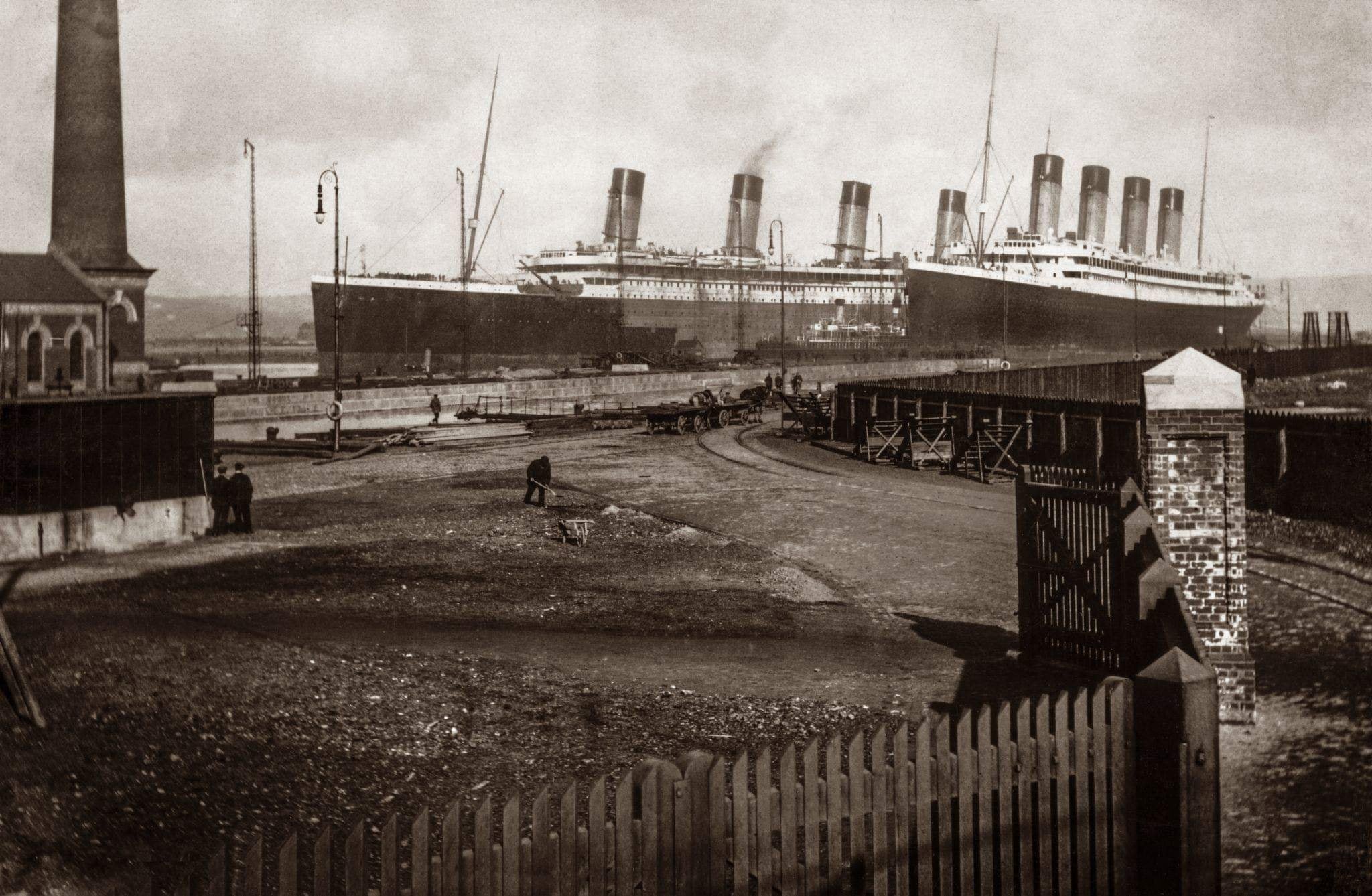
Titanic waits along side in the Fitting Out Wharf.

H&W workers with Olympic's damaged propeller.

On March 4th, the repairs on Olympic were completed, and she was withdrawn from the drydock. However, due to bad weather she was unable to leave. It was decided to return her to the drydock until the weather improved, as room in the shipyard was restricted. The next day Harland & Wolff made the decision to try something very risky. They moved Olympic out of the drydock, eased Titanic back into the drydock, and then moved Olympic to the fitting-out wharf, all on the one high tide.

Titanic back in the drydock, while Olympic sits in
the Fitting Out Warf.

By March 7th, weather conditions had improved sufficiently enough for Olympic to leave Belfast and head for Southampton. On leaving, she briefly went aground near West Twin Island, but was cleared to sail after divers had checked the hull. The repairs to Olympic forced Titanic's scheduled maiden voyage to be postponed from March 20th to April 10th, 1912.

Titanic and Olympic sit side by side for the last
time as Olympic prepares to leave for Southampton.
March 7, 1912


Timeline Article: Titanic is Launched!

Titanic's hull in the Arrol Gantry awaiting her launch.
On May 31, 1911, people from all over Belfast come to see the launch of Titanic. It has been 7 months since Olympic's launch and Titanic has been highly anticipated.

Harland and Wolff's president Lord William Pirrie and his wife, both celebrating birthdays, host a group of distinguished guests for the launch.


Titanic's hull sliding down the slipway.

Aided by 23 tons of soap, animal fat, and train oil spread on the slipway, the ship slides into the Lagan River. The massive empty hull of Titanic reaches 12 knots and stops 1 minute later.

Ship worker James Dobbins was fatally injured by a falling timber support during the launch. Unaware of this mishap, White Star officials celebrate the launch of Titanic and accept the completed Olympic as part of the fleet.

Titanic's hull launched into the Lagan River.

Titanic is towed to the dry dock for completion and Olympic is sailed to Liverpool to prepare for her maiden voyage.


RMS Olympic on her maiden voyage.


Timeline Article: From the Drawing Board to the Real World - Olympic's First Keel Plate is Laid

A postcard showing the new Arrol Gantry at Harland and Wolff.
Late 1908, the dream of the next generation of ocean liners moves from the draftsman's table to the real world. To accommodate the building of the massive size of the new Olympic Class ships. Harland and Wolff has to convert 3 of their already huge slipways into 2 bigger slipways. By the end of 1908, Harland and Wolff had designed the tallest gantry ever that stood over the slipways.
This gantry, known as the Arrol Gantry named after Sir William Arrol. He was a Scottish civil engineer and was contracted by Harland and Wolff to construct the enormous gantry. The gantry was equipped with heavy machinery for the construction of steel ships. Also, bridges that would allow the ship workers to get from one end to the other. This system of construction made it possible to build ships as big as Olympic, Titanic, and Britannic.

Olympic's keel being laid underneath the gantry.

Once the gantry was completed. Harland and Wolff started to hire ship workers in record numbers. They lay Olympic's first keel plate beneath the gantry that towers over Belfast. The Lagan River behind the gantry and had to be dredged to 50 feet to accommodate the launch of these new super liners, and to support ships with a deeper draft. Meanwhile back in Southampton, White Star arranges for similar dredging. While all this is taking place, Bruce Ismay is in America doing whatever is necessary to make sure that the piers in New York will be long enough for his liners to dock.


Featured Article: What Happened To Gigantic?

An unauthorized publication
showing the name "Gigantic".
One of the most enduring myths surrounding the Titanic story is actually about her younger sister, Britannic...

In the summer of 1907 when the Olympic Class liners were conceived, only Olympic and Titanic had been officially named. Since the two ships were going to be built side by side at the same time. White Star wanted to add a third ship later, but it was never given an official name at the time. The three ships had hull numbers and were listed as 400, 401, and 433. The public in Belfast knew about the White Star Line's order for 3 new ships and knew of Olympic and Titanic, but they were curious about the third ship's name. As curiosity grows, unauthorized publications such as posters and articles about the three liners began to circulate. A poster like the one pictured (above left) was an unofficial publication advertising "Gigantic" as the third ship in the class. Since White Star always branded its publications, this particular one does not belong to White Star. 

During the early stages of construction, there was photographic evidence that the third and final ship of the class was named "Britannic" and not "Gigantic".

Framing and plating of Britannic in 1912.
Notice the plaque reading
"White Star Royal Mail Steamer Britannic".

After Titanic sank, a rumor began to circulate that the White Star Line had indeed planned to name the third ship "Gigantic" but then changed the name after the Titanic sank to avoid the appearance of arrogance. 

White Star denied these claims at the Titanic inquiries. It was made known that by the time the first ship Olympic was launched in October of 1910, all of the Harland and Wolff documented records indicated that the third ship of the class was to be named "Britannic".

For years I (Joshua Allen Milford) had believed the above rumor was true. However, I became curious about the name change and wondered if there was really any name change at all. I contacted the Titanic Historical Society for help. I stated the question of the name change and the origin of the "Gigantic" poster. 

This is the response that I received:

"The origin of the poster that you illustrate is extremely vague, but it is quite certain that it was not a piece of official White Star Line publicity. Nor did it have anything to do with Harland and Wolff. What is certain is that as of October 1911, the only name in the available Harland and Wolff records is Britannic. None of the documents at the Public Record Office of Northern Ireland (PRONI) record any name changes even after the vessel had been ordered, which was almost six months before the Titanic went down."

-Simon Mills
 Britannic Wreck owner
 and Olympic Class Historian


"If it is of any assistance in all my years as Archive Manager in H & W I can confirm I never saw any official reference to the name Gigantic being used or proposed for the third of the Olympic class vessels. In any event the name of the vessel would be of only passing interest to us as the vessel number, in this case 433, would be the principal identifier."

-Tom McCluskie
 Harland and Wolff Archive Manager
 and Harland and Wolff Historian

An official White Star publication advertising
Britannic in her intended livery, before
she was requisitioned to be a hospital ship. 

I believe this proves that White Star never changed the name from "Gigantic" to "Britannic", and that the records indicate that the name "Britannic" was the official name before Titanic sank. Perhaps the name "Gigantic" was simply suggested during the time the 3 ships were being conceived but never made official.

HMHS Britannic
(Painting By: Ken Marschall)
The only thing that had changed about her name was the prefix. She was supposed to be named "RMS Britannic", just like RMS Olympic and RMS Titanic, but lost that title due to the outbreak of World War I. Before she could be completed, she was requisitioned to serve as a hospital ship by the British Admiralty. She took the name "HMHS Britannic" which stood for "His Majesty's Hospital Ship Britannic".

After completing 5 successful voyages as a hospital ship, she was considered the finest hospital ship afloat. On November 21, 1916, Britannic was on her 6th voyage when she struck an underwater mine off the coast of the Greek island of Kea in the Aegean Sea.

HMHS Britannic

She sank in only 58 minutes taking 30 out of 1,036 lives. She was the largest ship lost in WWI and is the largest ocean liner on the sea floor to this day.

Britannic sinking off the coast of
Greece near Kea Island.
(Painting By: Ken Marschall)

The wreck of the HMHS Britannic.
(Painting By: Ken Marschall)


Timeline Article: Contract Signed for the Olympic Class Ships


On September 17, 1908, a contract is signed to start construction for the Olympic Class Liners that were envisioned the previous year. Bruce Ismay and other White Star members arrive in Belfast, Ireland to review Harland and Wolff's construction plans. Chairman of H&W, William Pirrie presents the drawings with the assistance of his nephew, the managing director and head of the drafting department, Thomas Andrews. 

Ultimately, they decide that they will build Olympic and Titanic side by side as identical twin sisters, then build Britannic later. This decision signals an economic boom for Belfast whose main industry is shipbuilding. This also gives a higher profile to Southampton, which is rapidly becoming the leading passenger port for England.

William Pirrie (left) Thomas Andrews (right)


Timeline Article: The Beginning of the White Star Line

Oceanic (1871)
1868 - 1871

The North Atlantic is one of the harshest oceans on the planet. In the early days of overseas travel the passengers were exposed to awful unsanitary conditions and were likely to die of disease or to be shipwrecked and drowned. These were the days of sail, and it would take weeks or even months to get from continent to continent. While traveling to Boston, Charles Dickens wrote about his ship and described it as being like "a gigantic hearse with windows in the side." And of his bunk he wrote: "Nothing smaller for sleeping in was ever made, except coffins." Even though ships sailed on fixed schedules, out of every 100 ships to set sail 16 would never make it to their destination, some vanishing without a trace. Towards the late 19th century travel across the North Atlantic was increasing. Ships needed to be more comfortable, stylish, and fast. Shipbuilders advance to meet these needs and with each advance the voyage across the Atlantic or the Transatlantic run takes less time. Not only did ships need to carry passengers they also needed to carry mail. Ships were needed and so the era of the of the North Atlantic shipping lanes had begun.

Thomas Henry Ismay
On January 18, 1868, Thomas Henry Ismay, a Liverpool businessman, purchased the house flag, trade name, and goodwill of a bankrupt shipping line called the White Star Line that was originally founded in 1845. It was a fleet of clipper ships that operated between Britain and Australia. Ismay's intention was to establish a service of large steamships on the North Atlantic between Liverpool and New York.

One night during a game of billiards at a pool hall in Liverpool, Ismay was approached by Gustav Schwabe, a prominent Liverpool merchant, and his nephew, Gustav Wolff. Schwabe offered to finance the new shipping line only if Ismay had his ships built by Wolff's shipbuilding company, Harland and Wolff in Belfast, Northern Ireland. Ismay agreed, and the beginning of a long-lasting partnership between White Star and Harland and Wolff was created.

The agreement was that Harland and Wolff would build the ships at cost plus a fixed percentage and would not build any vessels for the line's rivals.

In 1870, Ismay and his longtime friend William Imrie form a new managing firm called Ismay, Imrie and Company. Ismay incorporates the White Star Line as the Oceanic Steam Navigation Company, Ltd. Despite this complex organization, the shipping company was known publicly throughout its existence as the White Star Line.

White Star places an order with Harland and Wolff for a class of six revolutionary liners. They will be called Oceanic, Atlantic, Baltic, Republic, and then followed by the slightly larger Celtic and Adriatic. The first ship of the class, Oceanic, will set sail on her maiden voyage in 1871.